Brief History of Inequality
Since the earliest days of capitalist development, inequality has captivated policymakers and researchers alike. By the time Kuznets penned his influential article, a lot of water had gone under that bridge.
The Physiocrats and primarily Classical Political Economy—spearheaded by Adam Smith—deserve particular mention. They placed inequality at the very heart of the theoretical framework, probing how wealth diffused among different social classes. This led to comprehensive theories of distribution, most notably those of Ricardo and Marx, whose approaches diverged sharply. Ricardo closely examined how wages, profits and rents were distributed among three classes, all of which were prone to conflict. Marx added the dimension of exploitation and argued that inequality and social unrest were structural features of capitalism.
The late 19th century saw the emergence of the empirical tradition. Booth and Rowntree, among others, conducted empirical investigations into poverty that rattled the English public, although Engels anticipated them by almost half a century with his classic work on the English working class, showing that wages were essentially stagnant while productivity increased rapidly. A decade or so later, Bowley’s statistical innovations provided the methodological building blocks for long-run inequality measurement that recent authors have successfully deployed.
Almost simultaneously, the so-called “marginal revolution” in economics dramatically shifted the analytical lens from social to personal distribution. As a result, inequality faded from the mainstream focus, perhaps with the notable exception of Pigou, who, in the early 20th century, established the foundations of welfare economics. It fell to thinkers such as J. Hobson, Veblen, R.H. Tawney, and Kalecki—some of whom were not strictly economists—to keep the study of inequality alive.
Pareto is a striking case: once a central figure among the marginalists and still frequently quoted by mainstream economists, he soon became disenchanted, redirected his formidable intellect toward sociology, and openly critiqued his former colleagues. His empirical finding—that the upper tail of income distributions follows a power law across very different societies—was one of the first systematic empirical regularities in inequality data. But his concept of Pareto optimality simultaneously provided a seemingly technical justification for excluding redistribution from economics, thereby preventing the dreaded politicization of the field.
Arguably, many of these thinkers were motivated to develop distributional theories to illuminate inequality under capitalism and guide real-world policy. It’s important to recall that trustworthy data on inequality was rare—and even when available, often questionable. Making robust empirical research was therefore a genuine challenge. Since mainstream economics did not prioritize inequality, official statistics typically looked elsewhere. Moreover, research on inequality conducted by those outside the dominant economics school was largely ignored.
Kuznets Hypothesis Reception
Broadly speaking, this was the backdrop for Kuznets’s landmark 1955 article. By then, the Cold War was in full swing—a reality a Russian émigré like Kuznets could hardly ignore. The Korean War had just ended, while Senator McCarthy was already actively pursuing “communists.” In a way, his main hypothesis that (capitalist) economic growth eventually leads to less inequality does fit a Cold War atmosphere. Notably, Kuznets’s article was not a formal paper but the text of his 1954 presidential speech at the annual meeting of the American Economic Association. It is also unclear how familiar Kuznets was with the aforementioned heterodox authors, as his research on the topic does not reference them. Nonetheless, as we will see, he could also be considered somewhat of an outsider to mainstream economics, given his particular approach to the field.
Oddly enough, the article’s publication did not immediately trigger a large influx of research. In fact, it was mostly overlooked. A few researchers began following his cues in the 1960s (see references below). Kravis (1960) and Oshima (1962) perhaps represented the most substantive early engagements, but their research was essentially data analysis rather than theoretical development. Moreover, Kuznets himself moved on to study long-run growth research.
Nevertheless, the tide began to change in the early 1970s, as both supporters and critics emerged. With more relevant data available, most research centered on developing econometric models to test his inverted-U hypothesis. Institutionally, the World Bank, under McNamara’s leadership, played a key role by commissioning research on inequality and household income. Furthermore, the 1969 ILO’s World Employment Programme which targeted global poverty, also contributed.
By the end of the 1970s, inequality research had decreased significantly after an earlier rapid increase. Monetarism, neoliberalism and structural adjustment took over the policy agenda. Research activity did not resume until the mid-1990s. At that point, inequality in advanced economies began to rise again, challenging Kuznets’ hypothesis. Twenty years later, Piketty introduced substantial new criticisms. Supporters of Kuznets’ work responded, adding more armor to protect the crumbling fort.
Three Schools of Thought
Analysis of the selected references at the end of this post, which include both early groundbreaking research and recent contributions, allows us to categorize them into separate clusters. Applying Hegelian logic to succinctly capture them, I can divide most of this work into three closely interrelated groups, corresponding to the three moments of Hegel’s Logic: 1. Abstraction—understanding. 2. Dialectical reason—negation. 3. Speculative reason—negation of negation.
1. The Core Kuznets Team
The first group comprises what I call the Core Kuznets team (CKT). This group comprises the pioneers who fully understood the hypothesis’s internal logic and developed empirical methods to test it.
Yet, CKT is not homogeneous. From a theoretical perspective, two distinct subgroups emerge: the empiricists and the structuralists. Both groups included critics who sought greater precision and improved estimation methods.
The CKT empiricists primarily used econometric techniques to test the inverted-U hypothesis, generally relying on the basic Kuznets model I described in the previous post. They were predominant in the 1970s, well represented by Paukert (1973), Ahluwalia (1976a, 1976b), Robinson (1976), and subsequently by Barro (2000) and Thornton (2001).
In contrast, the CKT structuralists dominated from the late 1990s. They leveraged more sophisticated models that incorporated parameters such as urbanization, education, financial development, and institutional change. They also had access to more reliable data. Key contributions include Galor and Tsiddon (1996), Glomm and Ravikumar (1998), Greenwood and Jovanovic (1990), and Higgins and Williamson (1999). Proponents of the environmental Kuznets curve, emerging in the 1990s—beginning with Grossman and Krueger (1991) and reinforced by a large subsequent literature—also belong to this team, having applied the inverted-U logic to pollution and environmental degradation. However, it is well known that in econometrics, introducing additional variables into a given model typically improves performance—as long as issues such as misspecification, autocorrelation, multicollinearity, and heteroskedasticity are properly addressed. Overfitting can thus be a critical challenge for CKT structuralists.
2. The Dialectical Kuznets Team
The second group, notably smaller, is the dialectical Kuznets team (DKT), led by Piketty and his collaborators. DKT challenged the purported dynamics of the inverted-U hypothesis and questioned its long-term validity. Its research suggested that the inverted-U curve applied only to a specific period: essentially, from the end of WWI to the late 1960s and early 1970s, triggered by exogenous shocks (war, social upheaval, etc.) rather than by exogenous mechanisms. Since then, inequality has followed a U-shaped curve, as discussed previously.
In other words, Kuznets could not see the forest for the trees. While the empirical negation of the curve can be deemed as relative, the theoretical one is absolute in Hegelian speak. Indeed, DKT posits that rising inequality is an internal feature of modern capitalism. It is a feature, not a bug. The r > g mechanism provides the endogenous theoretical foundation. On that basis, it proclaims that only targeted policies and state intervention can alter this trajectory. That is an anathema to the neoliberal establishment, of course. Unlike CKT, DKT’s approach differs in that it grounds its critique in sound theoretical foundations. Addressing its challenge will thereby require an alternative analytical framework. Throwing in more creative econometric models alone will not suffice.
3. The Speculative Kuznets Team
The speculative Kuznets team (SKT) is led by Milanovic and supported by recent research. It tackles the challenge head-on in its attempt to rescue the battered Kuznets curve from dialectical obliteration. However, the negation of the negation does not entail a return to the CKT realm. The creative mechanism Milanovic deploys relies on Kuznets cycles (or waves), which occur every 15 to 25 years. The development of new general-purpose technologies triggers such waves. At the beginning of every new wave, inequality tends to increase, but eventually it reverses. Here, the Kuznets curve comes back swinging. However, the original assumption that long-term economic growth reduces inequality has now vanished, while the detailed mechanism explaining why inequality dynamics are cyclical is missing. The same goes for its inflection point within each Kuznets cycle. Compared to Piketty’s endogenous mechanisms, SKT’s framework still needs to do more work to fully negate the negators. While creative, it remains highly descriptive and speculative.
SKT could have introduced Kondratiev’s long waves instead, which Kuznets himself studied. Such long waves last 50 years and are partly triggered by technological innovation. Authors such as Schumpeter, Freeman, C. Perez, Mandel, Tylecote, and D. M. Gordon have done extensive work on the subject. Although agreement on their internal dynamics has not been reached, each author provides a sound analytical framework for explaining them. Plugging in the Kuznets curve into any of them is thus quite plausible.
Back to the Curve
Note that Kuznets did not specify a timeline for his inverted-U curve. The scant data he shares in his original article covers, for example, over 50 years in the UK and Germany. Moreover, the U.S. graph I shared in the previous post spans 112 years, suggesting that the dynamics of inequality may be better captured by long-wave curves.
We can redo that chart and include only the years Kuznets originally considered. From the econometric analysis of the basic model, I can identify significant breakpoints (or inflection points) in 1924, 1942, 1966 and 1981. The graph below depicts the Kuznets curve for the period 1913-1955, the year his article was published.
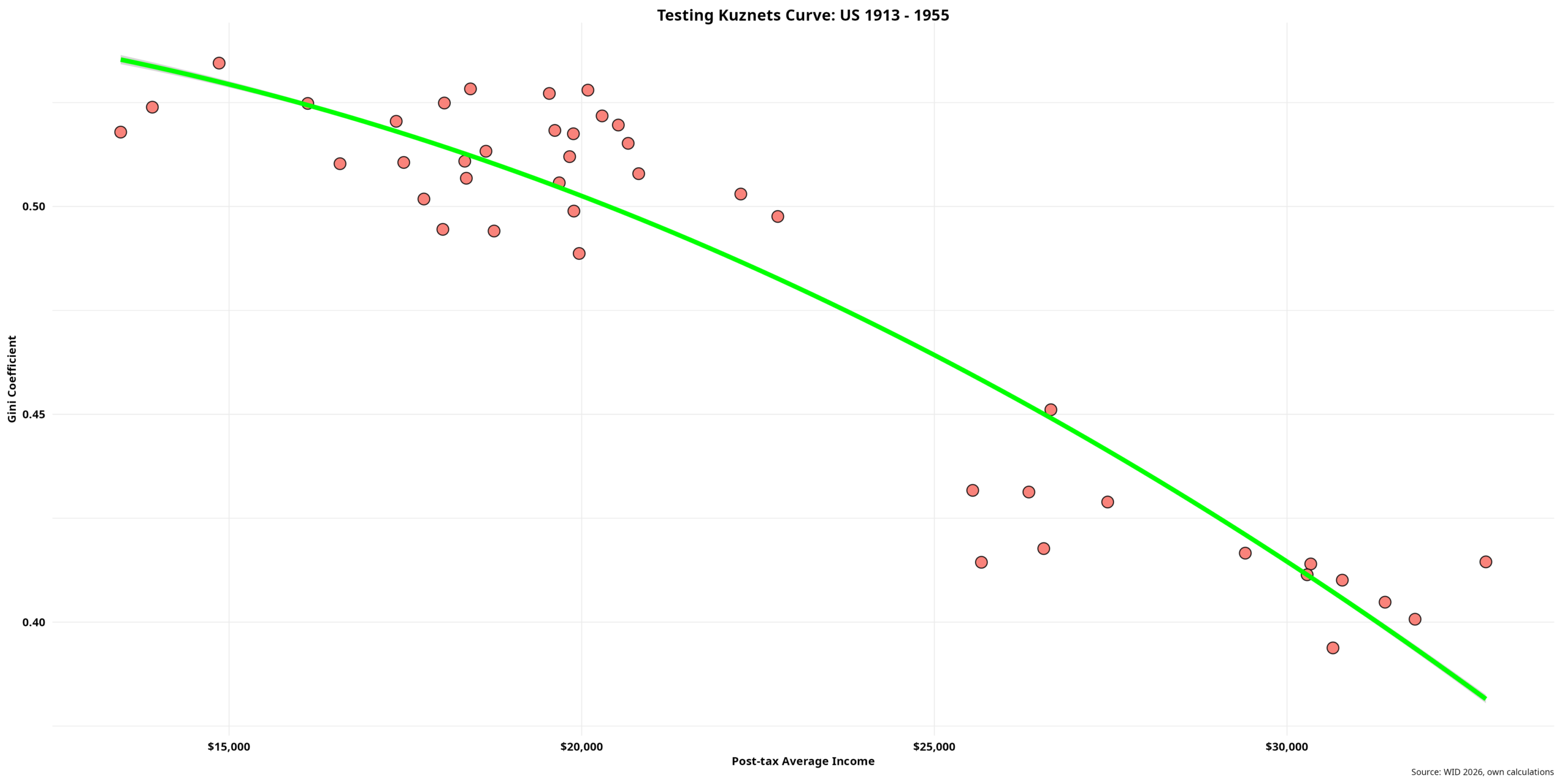
Although a complete inverted-U curve does not emerge, the data indicate a consistent decrease in inequality since 1913. That supports the temporary validity of Kuznets’s hypothesis. However, it is unlikely that Kuznets anticipated the pronounced reversal that commenced in the early 1960s and intensified after 1981, shortly before his death. The timeline is also pertinent to our analysis, as it substantiates the notion that Kondratiev’s long waves are best suited to sustain the prospective resurgence of the Kuznets curve, as promoted by SKT over the past decade.
Raul
References
Acemoglu, D., & Robinson, J. A. (2002). The Political Economy of the Kuznets Curve. Review of Development Economics, 6(2), 183–203. https://doi.org/10.1111/1467-9361.00149
Aghion, P., Caroli, E., & García-Peñalosa, C. (1999). Inequality and Economic Growth: The Perspective of the New Growth Theories. Journal of Economic Literature, 37(4), 1615–1660. JSTOR. https://doi.org/10.1257/jel.37.4.1615
Ahluwalia, M. S. (1976). Income Distribution and Development: Some Stylized Facts. The American Economic Review, 66(2), 128–135. JSTOR.
Ahluwalia, M. S. (1976). Inequality, poverty and development. Journal of Development Economics, 3(4), 307–342. https://doi.org/10.1016/0304-3878(76)90027-4
Ajanaku, B. A., & Collins, A. R. (2021). Economic growth and deforestation in African countries: Is the environmental Kuznets curve hypothesis applicable? Forest Policy and Economics, 129, 102488. https://doi.org/10.1016/j.forpol.2021.102488
Anand, S., & Kanbur, S. M. R. (1993a). The Kuznets process and the inequality—Development relationship. Journal of Development Economics, 40(1), 25–52. https://doi.org/10.1016/0304-3878(93)90103-T
Anand, S., & Kanbur, S. M. R. (1993b). Inequality and development A critique. Journal of Development Economics, 41(1), 19–43. https://doi.org/10.1016/0304-3878(93)90035-L
Aquilas, N. A., Mukong, A. K., Kimengsi, J. N., & Ngangnchi, F. H. (2022). Economic activities and deforestation in the Congo basin: An environmental Kuznets curve framework analysis. Environmental Challenges, 8, 100553. https://doi.org/10.1016/j.envc.2022.100553
Atkinson, A. B. (1970). On the measurement of inequality. Journal of Economic Theory, 2(3), 244–263. https://doi.org/10.1016/0022-0531(70)90039-6
Barro, R. J. (2000). Inequality and Growth in a Panel of Countries. Journal of Economic Growth, 5, 5–32. https://doi.org/10.1023/A:1009850119329
Baymul, Ç., & Sen, K. (2019). Kuznets Revisited: What Do We Know about the Relationship between Structural Transformation and Inequality? Asian Development Review, 36(1), 136–167. https://doi.org/10.1162/adev_a_00126
Baymul, C., & Sen, K. (2020). Was Kuznets Right? New Evidence on the Relationship between Structural Transformation and Inequality. The Journal of Development Studies, 56(9), 1643–1662. https://doi.org/10.1080/00220388.2019.1702161
Bourguignon, F., & Morrisson, C. (1998). Inequality and development: The role of dualism. Journal of Development Economics, 57(2), 233–257. https://doi.org/10.1016/S0304-3878(98)00089-3
Branco, K. J., & Williamson, J. B. (1988). Economic Development and Income Distribution: A Cross-National Analysis. The American Journal of Economics and Sociology, 47(3), 277–297. JSTOR. https://doi.org/10.1111/j.1536-7150.1988.tb02040.x
Breunig, R., & Majeed, O. (2020). Inequality, poverty and economic growth. International Economics, 161, 83–99. https://doi.org/10.1016/j.inteco.2019.11.005
Chancel, L., & Piketty, T. (2021). Global Income Inequality, 1820–2020: The Persistence and Mutation of Extreme Inequality. Journal of the European Economic Association, 19(6), 3025–3062. https://doi.org/10.1093/jeea/jvab047
Deininger, K., & Squire, L. (1996). A New Data Set Measuring Income Inequality. The World Bank Economic Review, 10(3), 565–591. https://doi.org/10.1093/wber/10.3.565
Deininger, K., & Squire, L. (1998). New ways of looking at old issues: Inequality and growth. Journal of Development Economics, 57(2), 259–287. https://doi.org/10.1016/S0304-3878(98)00099-6
Dinda, S. (2004). Environmental Kuznets Curve Hypothesis: A Survey. Ecological Economics, 49(4), 431–455. https://doi.org/10.1016/j.ecolecon.2004.02.011
Eastin, J., & Prakash, A. (2013). Economic Development and Gender Equality: Is There a Gender Kuznets Curve? World Politics, 65(1), 156–186. https://doi.org/10.1017/S0043887112000275
Ferreira, F. H. G., Moramarco, D., & Peragine, V. (2025). Economic development and inequality of opportunity: Kuznets meets the Great Gatsby? Structural Change and Economic Dynamics. https://doi.org/10.1016/j.strueco.2025.11.006
Fogel, R. W., Fogel, E. M., Guglielmo, M., & Grotte, N. (2013). Political Arithmetic: Simon Kuznets and the Empirical Tradition in Economics. University of Chicago Press.
Fogel, R. W. (1987). Some Notes on the Scientific Methods of Simon Kuznets (SSRN Scholarly Paper No. 227103). Social Science Research Network. https://papers.ssrn.com/abstract=227103
Freeman, C., & Perez, C. (1988). Structural Crises of Adjustment: Business Cycles and Investment Behaviour. In In Dosi, G. et.al (ed) Technical Change and Economic Theory (pp. 38–66). Francis Pinter.
Freeman, C. (Ed.). (1984). Long waves in the world economy. Pinter.
Galbraith, J. K., Kanbur, R., Sen, K., Sumner, A., & UNU-WIDER. (2025). Kuznets at 70: The enduring significance of a curve and a hypothesis (WIDER Working Paper No. 2025; WIDER Working Paper, Vol. 2025). UNU-WIDER. https://doi.org/10.35188/UNU-WIDER/2025/605-6
Galor, O., & Tsiddon, D. (1996). Income Distribution and Growth: The Kuznets Hypothesis Revisited. Economica, 63(250), S103–S117. https://doi.org/10.2307/2554811
Glomm, G., & Ravikumar, B. (1998). Increasing returns, human capital, and the Kuznets curve. Journal of Development Economics, 55(2), 353–367. https://doi.org/10.1016/S0304-3878(98)00040-6
Gordon, D. M. (1980). Stages of accumulation and long economic cycles, in Processes of the World System (pp. 9–46). SAGE Publications.
Grossman, G. M., & Krueger, A. B. (1991). Environmental Impacts of a North American Free Trade Agreement (Working Paper No. 3914). National Bureau of Economic Research. https://doi.org/10.3386/w3914
Hecht, J. (2025). Are Long Waves 50 Years? Reexamining Economic and Financial Long Wave Periodicities in Kondratieff and Schumpeter. Review of Political Economy, 37(4), 1681–1715. https://doi.org/10.1080/09538259.2023.2280803
Higgins, M., & Williamson, J. G. (1999). Explaining Inequality the World Round: Cohort Size, Kuznets Curves, and Openness (Working Paper No. 7224). National Bureau of Economic Research. https://doi.org/10.3386/w7224
Jovanovic, B. (2018). When is there a Kuznets curve? Some evidence from the ex-socialist countries. Economic Systems, 42(2), 248–268. https://doi.org/10.1016/j.ecosys.2017.06.004
Kanbur, R., Ortiz-Juarez, E., & Sumner, A. (2024). Is the era of declining global income inequality over? Structural Change and Economic Dynamics, 70, 45–55. https://doi.org/10.1016/j.strueco.2024.01.002
Keijzer, S. & Sen, K. (2025). Revisiting the Kuznets curve, 70 years on (WIDER Working Paper No. 2025; WIDER Working Paper, Vol. 2025). UNU-WIDER. https://doi.org/10.35188/UNU-WIDER/2025/638-4
Kravis, I. B. (1960). International Differences in the Distribution of Income. The Review of Economics and Statistics, 42(4), 408–416. https://doi.org/10.2307/1925690
Kuznets, S. (1955). Economic Growth and Income Inequality. The American Economic Review, 45(1), 1–28. JSTOR.
Kuznets, S. (1963). Quantitative Aspects of the Economic Growth of Nations: VIII. Distribution of Income by Size. Economic Development and Cultural Change, 11(2, Part 2), 1–80. https://doi.org/10.1086/450006
Kuznets, S. (1967). [1930] Secular movements in production and prices: Their nature and their bearing upon cyclical fluctuations. Kelley.
Lakner, C., & Milanovic, B. (2016). Global Income Distribution: From the Fall of the Berlin Wall to the Great Recession. The World Bank Economic Review, 30(2), 203–232. https://doi.org/10.1093/wber/lhv039
Lessmann, C. (2014). Spatial inequality and development—Is there an inverted-U relationship? Journal of Development Economics, 106, 35–51. https://doi.org/10.1016/j.jdeveco.2013.08.011
Lydall, H. F. (1968). The structure of earnings. Clarendon.
Madsen, J., & Strulik, H. (2025). Taking Kuznets seriously. Journal of Economic Growth. https://doi.org/10.1007/s10887-025-09262-6
Mandel, E. (1995). Long waves of capitalist development: A Marxist interpretation; based on the Marshall lectures given at the University of Cambridge (2. rev. ed). Verso.
McDonough, T. (1999). Gordon’s Accumulation Theory: The Highest Stage of Stadial Theory. Review of Radical Political Economics, 31(4), 6–31. https://doi.org/10.1177/048661349903100402
Mdingi, K., & Ho, S.-Y. (2021). Literature review on income inequality and economic growth. MethodsX, 8, 101402. https://doi.org/10.1016/j.mex.2021.101402
Milanovic, B. (2016). Global Inequality: A New Approach for the Age of Globalization. Harvard University Press. https://doi.org/10.4159/9780674969797
Morgan, M. & Souza, P. (2025). Distribution in late development: The political economy of the Kuznets curse in Brazil (WIDER Working Paper No. 2025; WIDER Working Paper, Vol. 2025). UNU-WIDER. https://doi.org/10.35188/UNU-WIDER/2025/559-2
Naveed, A., Ahmad, N., FathollahZadeh Aghdam, R., & Menegaki, A. N. (2022). What have we learned from Environmental Kuznets Curve hypothesis? A citation-based systematic literature review and content analysis. Energy Strategy Reviews, 44, 100946. https://doi.org/10.1016/j.esr.2022.100946
Oshima, H. T. (1962). The International Comparison of Size Distribution of Family Incomes with Special Reference to Asia. The Review of Economics and Statistics, 44(4), 439–445. https://doi.org/10.2307/1926661
Özokcu, S., & Özdemir, Ö. (2017). Economic growth, energy, and environmental Kuznets curve. Renewable and Sustainable Energy Reviews, 72, 639–647. https://doi.org/10.1016/j.rser.2017.01.059
Pablo-Romero, M. del P., & De Jesús, J. (2016). Economic growth and energy consumption: The Energy-Environmental Kuznets Curve for Latin America and the Caribbean. Renewable and Sustainable Energy Reviews, 60, 1343–1350. https://doi.org/10.1016/j.rser.2016.03.029
Papanek, G. F., & Kyn, O. (1986). The effect on income distribution of development, the growth rate and economic strategy. Journal of Development Economics, 23(1), 55–65. https://doi.org/10.1016/0304-3878(86)90079-9
Paukert, F. (1973). Income Distribution at Different Levels of Development: A Survey of Evidence. International Labour Review, 108, 97–120.
Paul, S., & Sen, K. (2026). Kuznets in the Twenty-First Century: Mexico and United States Compared. Structural Change and Economic Dynamics. https://doi.org/10.1016/j.strueco.2026.02.007
Perez, C. (2003). Technological revolutions and financial capital: The dynamics of bubbles and golden ages (Repr). Elgar.
Piketty, T., & Saez, E. (2003). Income Inequality in the United States, 1913–1998*. The Quarterly Journal of Economics, 118(1), 1–41. https://doi.org/10.1162/00335530360535135
Piketty, T., Yang, L., & Zucman, G. (2019). Capital Accumulation, Private Property, and Rising Inequality in China, 1978–2015. American Economic Review, 109(7), 2469–2496. https://doi.org/10.1257/aer.20170973
Policardo, L., & Sanchez Carrera, E. J. (2024). Wealth inequality and economic growth: Evidence from the U.S. and France. Socio-Economic Planning Sciences, 92, 101804. https://doi.org/10.1016/j.seps.2024.101804
Ravallion, M., & Chen, S. (2021). Is that Really a Kuznets Curve? Turning Points for Income Inequality in China (Working Paper No. 29199). National Bureau of Economic Research. https://doi.org/10.3386/w29199
Robinson, S. (1976). A Note on the U Hypothesis Relating Income Inequality and Economic Development. The American Economic Review, 66(3), 437–440. JSTOR.
Roy Chowdhury, R., & Moran, E. F. (2012). Turning the curve: A critical review of Kuznets approaches. Applied Geography, 32(1), 3–11. https://doi.org/10.1016/j.apgeog.2010.07.004
Sen, A. K. (1997). From Income Inequality to Economic Inequality. Southern Economic Journal, 64(2), 384–401. JSTOR. https://doi.org/10.2307/1060857
Solomou, S. (1990). Phases of economic growth, 1850 – 1973: Kondratieff waves and Kuznets swings (1. paperback ed). Cambridge Univ. Press.
Stern, D. I. (2004). The Rise and Fall of the Environmental Kuznets Curve. World Development, 32(8), 1419–1439. https://doi.org/10.1016/j.worlddev.2004.03.004
Sundrum, R. M. (1974). Aspects of Economic Inequality in Developing Countries. The Bangladesh Economic Review, 2(1), 445–468. JSTOR.
Tang, D., Boamah, V., & Ben Amara, D. (2025). Revisiting the Environmental Kuznets Curve in West Africa: A spatial econometric analysis of growth, globalization, and emissions. Journal of Environmental Management, 395, 127723. https://doi.org/10.1016/j.jenvman.2025.127723
Tawney, R. H. (1979). Equality (4. impr). Allen & Unwin.
Tylecote, A. (2013). The Long Wave in the World Economy: The Current Crisis in Historical Perspective. Taylor and Francis.
Yao, S., Zhang, S., & Zhang, X. (2019). Renewable energy, carbon emission and economic growth: A revised environmental Kuznets Curve perspective. Journal of Cleaner Production, 235, 1338–1352. https://doi.org/10.1016/j.jclepro.2019.07.069
Zhang, J. (2026). Learning to Industrialize: Ideas, Institutions and Power in the Development of Industrial Parks in Ethiopia. Development and Change, 57(2), 377–406. https://doi.org/10.1111/dech.70053
