In 1936, Keynes published his famous opus, challenging mainstream economics. While his innovative contributions were indeed many, at least two are relevant for our purposes. For starters, deficit spending gave governments a decisive role in tackling economic crises and depressions through targeted interventions to revive private investment. Second, effective demand linked actual demand to production and capacity utilization while allowing for unemployment. That challenged both Say’s Law and the mainstream ideal of full employment. Effective demand stimulus via deficit spending was also positioned as a way to overturn economic crises. In other words, Keynes proposed new mechanisms to ensure capitalist development could be further sustained despite its cyclical nature. However, Keynesian policies only became a reality after the end of WWII. And they ruled the world until the 1970s.
The aftermath of the bloody war confrontations of the first half of the 20th century left most European states in a precarious situation. This opened the door for the consolidation of a new global hegemon now competing with the USSR, which claimed to be both non-capitalist and anti-capitalist. From the perspective of the Global South, the so-called “World Wars” were not, as most were not part of the confrontation nor had a direct stake in the conflict. On the other hand, most other non-European territories were still under colonial domination and thus had no direct say in international political conflict.
In that light, countries and territories outside of core capitalist development remained on the margins. As a result, they were usually not integral to the analysis, except for the European authors who addressed colonialism and imperialism directly. While most in Africa were still under colonial rule, the independent Latin American and Caribbean countries were expected to embrace capitalist development quickly, in the same fashion as their Western European counterparts. However, almost 120 years after independence, that was not actually happening on the ground. A more complex process was apparently brewing. And the specter of “communism” à la USSR was looming on the horizon after 1945.
That brings us to the other side of capitalist development: its negation, the absence of comprehensive, cohesive capitalist development in these countries and territories. From here, the modern idea of “development” emerged. It was initially a response to the lackluster performance of peripheral countries that somehow refused to follow Western developmental standards.
The end of WWII also brought the beginning of the end to good old bloody colonialism. The number of politically independent countries in the Global South rapidly increased in a relatively short span—nations that were facing a similar conundrum. The table below, compiled from multiple resources, including the WB and the UN, and my own research, summarizes such changes.
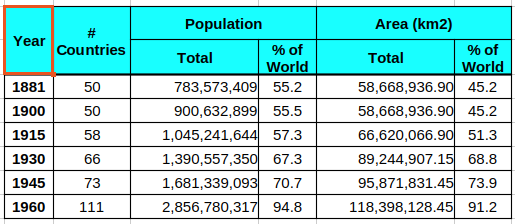
Between the beginnings of the so-called Scramble for Africa and the end of the 19th century, the data did not change at all. At the time, 45% of the world’s population living in 55% of the land had no independent political representation, with a few exceptions. The seven European powers, fighting tooth and nail to conquer Africa, were more than eager to expand their colonial frontiers, desperately searching for raw materials and other cheap commodities. Competition was the engine that motivated them to be ahead of all others, running on the coattails of the Second Industrial Revolution. Any similarities with today’s AI boom are not a coincidence, albeit contemporary economic coercion mechanisms are much more subtle in practice and democratic in theory. Meanwhile, non-European powers such as the US were concentrating their imperial ambitions in Latin America and Asia, thanks in part to the fall of the old Spanish empire. Japan, in particular, displayed extreme aggressiveness by invading China, Russia and Korea with little remorse.
Twenty-two out of the fifty independent countries in 1900 were former colonies, with the Americas taking 20 spots. Only two countries represented Africa while Asia contributed eight. European countries comprised 18 nations in addition to the Austro-Hungarian and Ottoman empires that were already running out of steam. It was a relatively small world then! However, flat it was not. Imperial powers dominated most continents, with Europe leading with seven. The U.S. and Japan were the sole imperial leaders in their regions, avoiding competition with them. Aside from Ethiopia and Liberia, Africa was, for the most part, the core target of the European imperial ambitions at the time.
A hierarchy of countries was thus already in place in Europe, Asia and the Americas. Southern European nations such as Portugal, Spain, Italy, Greece and Romania, where capitalist development was lagging, were considered the periphery of Europe, closer to Northern Africa in some accounts. Recall that Italy, Spain and Portugal had been imperial powers in the past and still held a few overseas territories under their control. Apparently, that did not matter. Latin American countries were a notch below, if that is at all possible. And so on. In sum, in 1900, nine countries ran international affairs for the most part, with little opposition from the rest and very few legal recourses to oppose intervention.
The table below showcases the top ten imperial powers for 1900, 1930 and 1960. Note that data for population and area are estimates, as data for a couple of countries (Ireland and Yemen) and many micro-states are not available. However, the estimation error is less than two percent in the worst-case scenario. Territorial counts might also be imprecise for the same reasons.
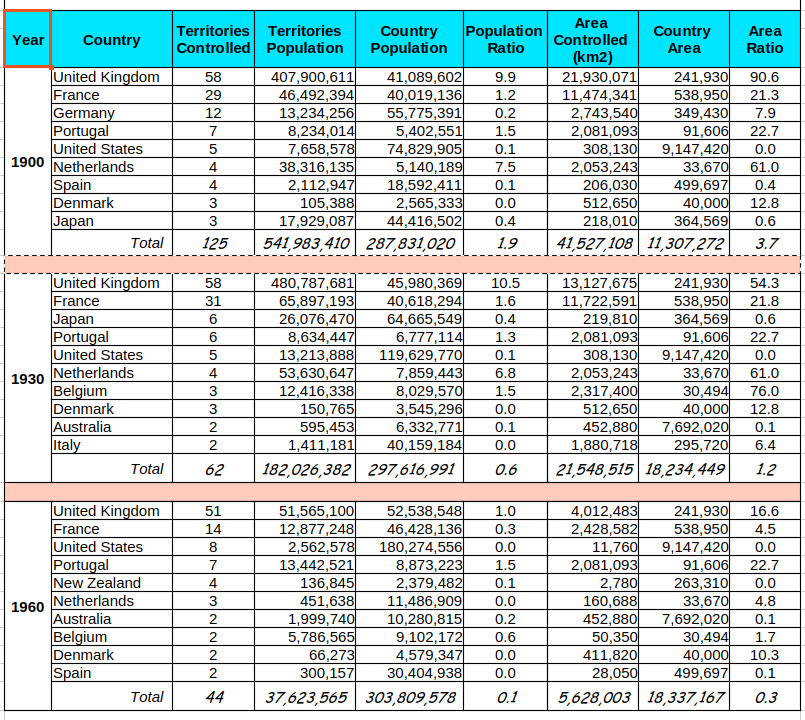
To understand the various table columns, let us look at the UK. In 1900, it had 58 territories under its control with a population of over 400 million people covering almost 22 million square kilometers. For every single UK inhabitant, it had almost 10 (9.9) people in the colonies. And for every square meter of land in the country, we could uncover 91 in the territories under its control. The Netherlands was the only country that had population and area ratios that got closer to that of the imperial hegemon.
By 1930, Australia, New Zealand, and South Africa were already independent countries, thus reducing the UK area ratio by almost 40 percent. At the same time, however, the dissolution of the Ottoman Empire added new territories such as Iraq, Palestine, and Jordan, in addition to Tanzania, previously under German control. Its population thus increased slightly. But perhaps the most notable change in the 30 years is the absence of Germany as a result of its WWI defeat. The Netherlands was able to keep its ratio more or less stable while Belgium became the leader in the area ratio thanks to its control of the Congo. At the macro level, we can detect a decline in overall colonialism in quantitative terms as 16 new countries gained independence in that time span.
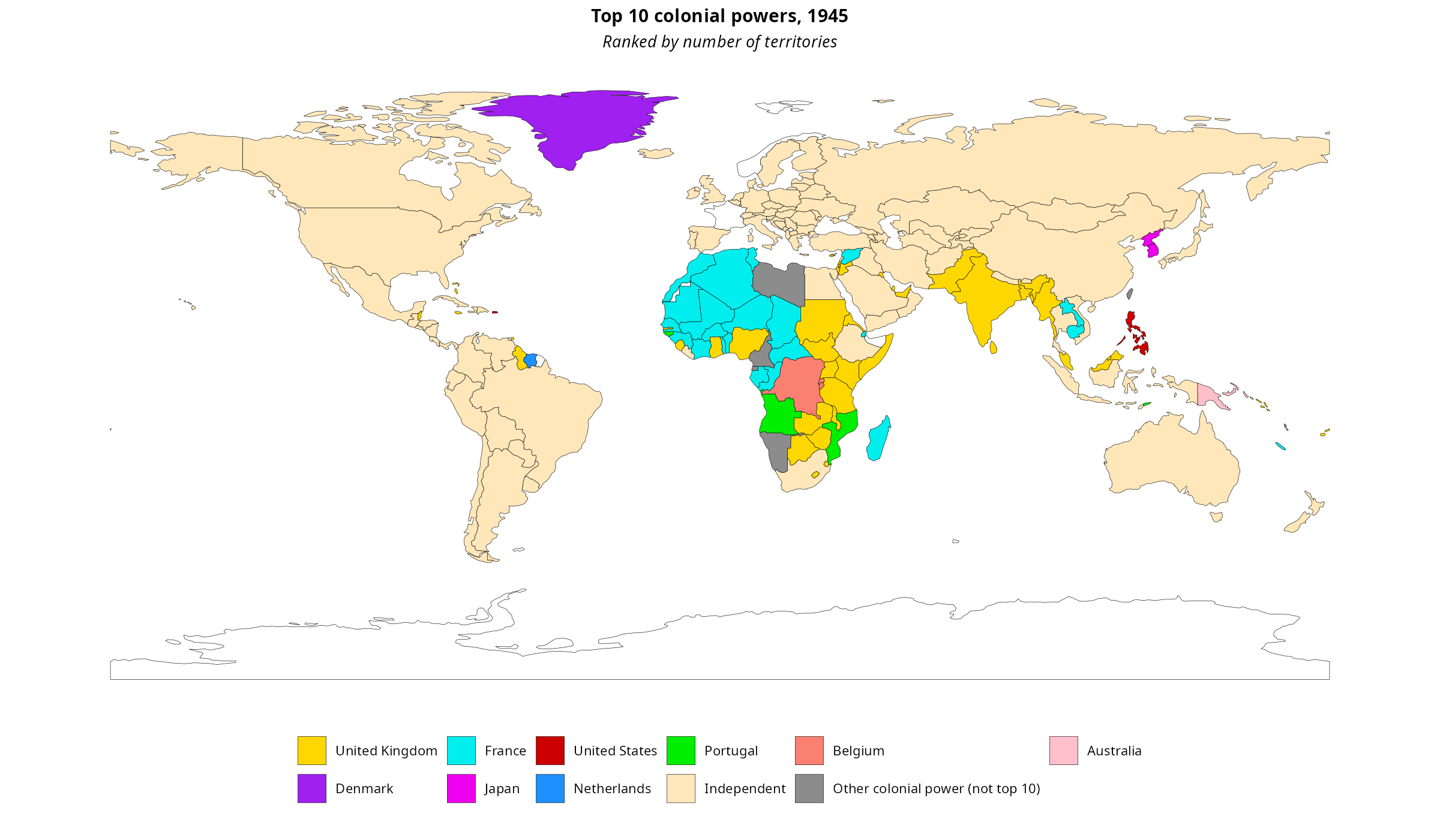
By 1960, the number of independent countries had more than doubled, propelled by the rise of anti-colonial movements on the African continent. And over 90 percent of the world’s population were living in politically independent nation-states.
From the above, a typology of countries for that time can be identified. First, the nine core imperial powers where capitalist development was the most advanced and its technological tools were deployed to support the vanquishing of other countries and territories. Second, a small set of European countries, including Belgium, Denmark, Sweden, and Switzerland, also rapidly embracing capitalist development that, by sheer size, could not effectively compete with the first group. Today, we would classify this group as middle powers. Third, a larger set of Southern and Eastern European countries where capitalism was still incipient. Many of those in the East, especially, were relatively new nations. Fourth, the Latin American and Caribbean countries, most of which gained independence in the early 19th century and had relatively low levels of capitalist development. And finally, the African and Asian nations, old and new, rebuilding themselves after the end of colonialism while striving to promote economic development via different routes. Needless to say, the situation today is different but not by huge margins.
This was the overall environment that saw the emergence of economic development theories. Now, there is an extensive literature on this that should be revisited by those interested. I will suggest consulting this handbook or this book for a much shorter introduction. The first we note in these references is that development is considered a neutral and natural process, not always linked to capitalism. A second, and perhaps more serious caution is the lack of distinction between authors sitting in imperial white towers writing about the topic and those living the development experience firsthand, having survived bloody colonialism and critically thinking about the future.
Raul
