For those of us who have been riding the socioeconomic roller coaster of digital technologies for years, the word “revolution” has lost much of its meaning. Since the advent of the PC (personal computer, just in case) in 1981, we have had no choice but to hear it ad nauseam. The PC revolution was then its first and last name. Like the archetypal impostor, it quickly adopted a new first name whenever a technological innovation emerged, comfortably accommodating it. Indeed, the number of industrial revolutions in the last two and a half centuries—four and counting—seems trivial compared to the almost unlimited number of allegedly profound digital disruptions we have witnessed over the past 40 years or so.
I have previously highlighted this hypeish feature of modern digital technologies. It frequently translates into superprofits for a few winners who usually come out on top. Some losers, in turn, make amends and devise comeback plans, with more hype in the mix, for sure. I have also analyzed the impact of this incessant process on policy development and development policies in the Global South. In a nutshell, it has become an endless chase that resembles Zeno’s paradox, while consuming scarce resources in mostly fruitless endeavors. Moreover, local innovation is routinely ignored or simply not considered innovative enough by Western standards to make the cut.
Today, we hear a lot about techno-feudalism (or no capitalism anymore!), intellectual monopoly capitalism, rentier capitalism, and vulture capitalism, most of which have emerged in the past five years. Is capitalism, as a term, experiencing the same fate as “revolution,” permanently changing with every emerging innovation?
Having already plenty of graying hairs on an always-decreasing number, a two-in-one senior perk, I did manage to remember last-century authors such as Bell, Baran & Sweezy, and Schwab, who also put forward conceptual innovations. While Schwab was walking down the utopian-capitalism route, the first two foresaw dramatic structural changes in actually existing capitalism.
To explore my apparently trivial question, I decided to do a quick rundown of the evolution of conceptual capitalism by decade, starting in the 1970s. Lately, I have been researching the latest varieties of capitalism espoused by much younger authors. Taking such a dive did, in fact, serve my long-term purposes.
The results are shown in the table below, split into two parts to keep column labels visible while scrolling. Needless to say, the compiled list is not exhaustive, nor was that my goal. For example, I have not included Castell’s network society, which is so familiar to many of us. It could, however, be subsumed under other broader categories. Moreover, a few have 2.0 sequels, which I have kept to highlight the impact of yet another series of technological “revolutions” on the same area. That said, the list is more of an initial shot. It is also an invitation to others in the community to dig deeper into the continuous conceptual reshaping of capitalism—while book sales try to regain momentum at every turn.
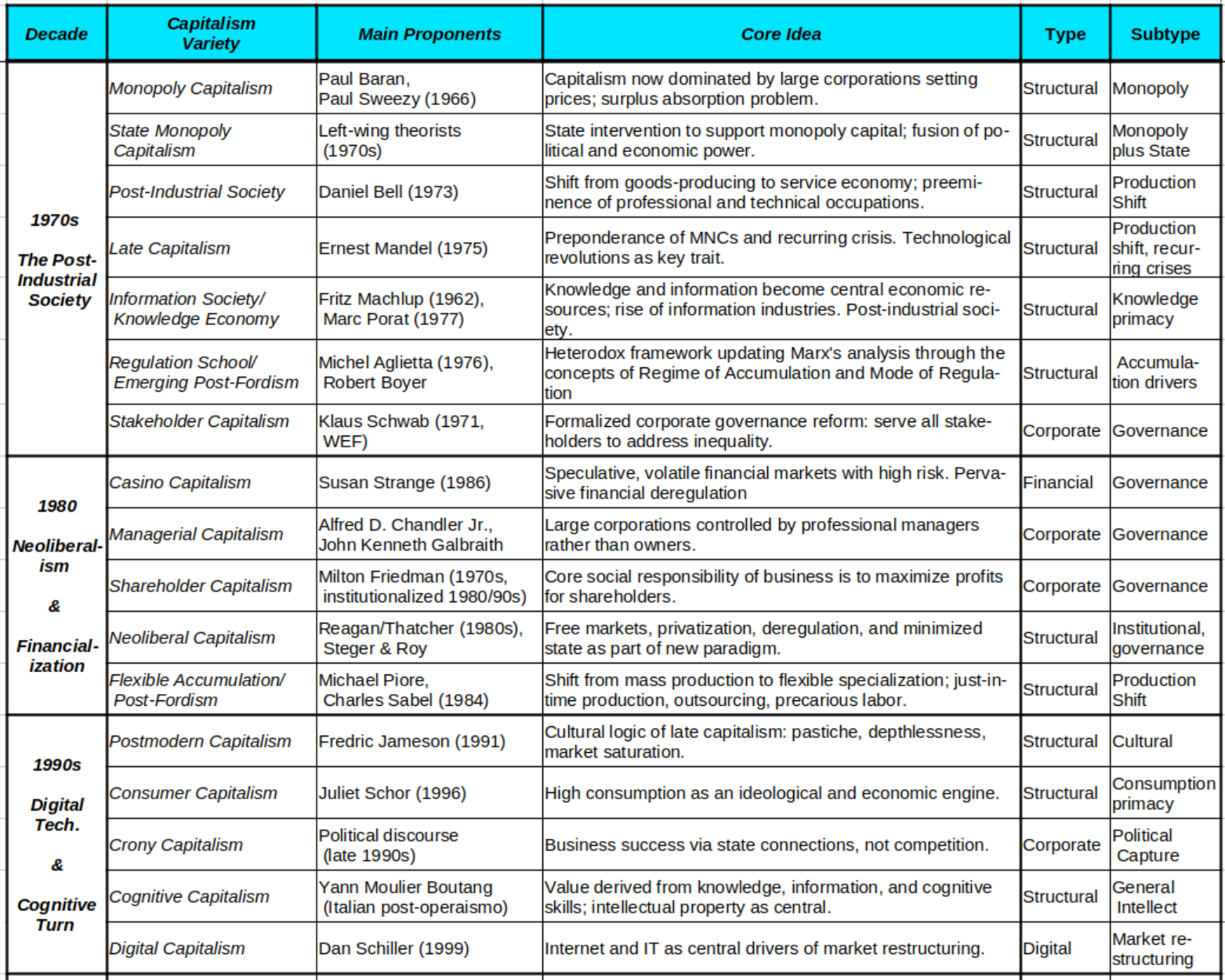
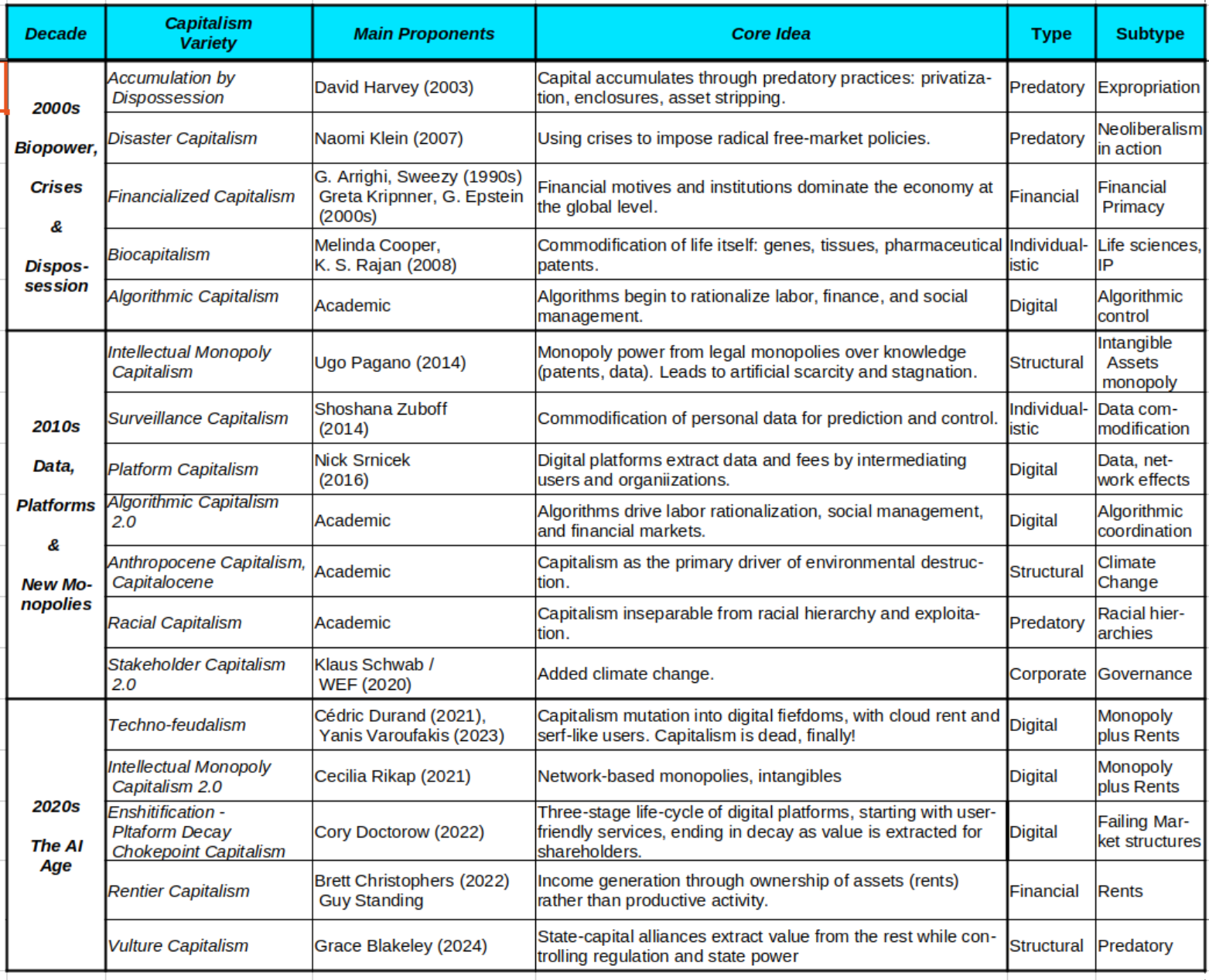
Not pretending to utter the last word, I have labeled each of the six decades covered by my expedited research with mostly familiar names. The core idea column contains my quick summary of each type of capitalism, which can surely be refined in future iterations. The last two columns depict my attempt to categorize each variety of conceptual capitalism, adding a subtype that pinpoints its main driver.
I ended up identifying 34 varieties of capitalism over 60 years. That surely beats the number of digital technology “revolutions” we have had to endure patiently over the past four decades. Inflationary capitalism beats permanent revolution, digital or not!
Note that most of the authors are critics of capitalism and draw on either liberal or progressive perspectives. That may be a sign that capitalism does not move linearly over time. Massive bumps and unexpected turns are more the rule. Exceptions such as Friedman and neoliberalism can be considered attempts to correct deviations from hardcore capitalism introduced by liberal or progressive governments that went astray and inexorably led to economic crises and crashes.
Conspicuously absent from the list are hardcore mainstream economists who tend to ignore structural changes and view the historical process as purely cumulative. Moreover, capitalism, often equated with markets, has existed almost everywhere since the dawn of time. Historical classifications are thus not at all relevant in this view. Capitalism will rule forever, so we are told, so stop looking for the exit door. And then they point fingers at critics for being “teleological.” Go figure.
A connection between conceptual capitalism and digital technologies is obviously present, especially with the advent of the Internet and the consolidation of so-called “digital capitalism,” a concept first developed by Schiller at the end of the millennium. Since then, most digital technology innovations have given rise to a new form of conceptual capitalism. Before that, economic disruptions were the main springs that pushed authors to reexamine the crisis-prone nature of capitalism.
My categorization of the multiple conceptual capitalisms is based on their authors’ core analytical targets, ranging from a whole-economy approach to individual-centered perspectives. In that light, I have identified six categories: 1. Corporate. 2. Digital. 3. Financial. 4. Individualistic. 5. Predatory. And 6. Structural. The most common are Structural (14), Digital (7), and Corporate (4), accounting for over 75 percent of all entries.
The data shows a shift at the end of the 1990s, coinciding with the emergence of “digital capitalism.” Before that, Structural and Corporate approaches dominated the scene, as all entries (15) except one were part of either. Since then, only three Structural and no Corporate have popped up on the conceptual horizon. That makes Digital the most prominent in the new millennium, with seven, followed by Predatory, with three.
We can thus conclude that we have two distinct cohorts of conceptual capitalism, with digital technologies being the main differentiator. That does not mean that technologies did not play a role in the cohort with the most gray hairs. On the contrary, many of the authors in this group were responding to genuine technical change that affected the global capitalist economy or large corporations. It just was not yet digital, however.
Relations between cohorts and categories also need to be explored. For example, the post-industrial society and the information society perspectives are clearly linked to Pagano’s original intellectual monopoly capitalism, later refined by Rikap in the early 2020s. Rentier capitalism is just another way of describing the financialization of the world economy, which began in the 1970s and was first described as the Casino Economy, later refined by Epstein et al.
One could also argue that platform capitalism falls under the older corporate category, including managerial and shareholder capitalism. However, note that the former applies only to corporations that run massive digital platforms, which are usually reduced to big tech and a few of its close pals. The old brick-and-mortar corporations, still very profitable and silently surviving, are thus excluded. In other words, the platform economy covers only a part of the entire economy.
That seems to be a consistent pattern with the perspectives classified as digital. While certainly intellectual monopoly capitalism looks beyond the digital sector, especially Pagano’s original take, most others assume that such a sector somehow represents the entire global economy. Their main target is typically big tech, which might blindside them.
To put varieties of digital capitalism in perspective, let us go to the data. Revenues for big tech (MAGAM) and Nvidia totaled almost 2 trillion USD, according to their respective 2024 annual SEC reports. Global GDP for that same year was around 117 trillion USD, according to the World Bank. Consequently, big tech’s share of the total global GDP is just 1.7 percent. Their market capitalization is 9 times their revenue, but this does not imply or guarantee any additional revenue. They still have to sell their digital wares in the always unpredictable market.
Furthermore, the digital economy, broadly defined—encompassing the global ICT sector, digital platforms, e-commerce, and tech services delivered digitally—accounted for around 15 percent (16 trillion) of global GDP that same year. Big tech’s share is thus also relatively small here. In any case, the U.S., the UK, Japan, Germany and South Korea are the top digital economies, with the first two accounting for over 65 percent of the total. The other 190-plus countries, representing over 6 billion people, share the other 35 percent.
Against this backdrop, the 400 million firms classified as small and medium enterprises (SMEs) generate around 50 percent of global GDP—30 times more than big tech—and 70 percent of global employment, according to the OECD and the WEF. And yet, they rarely figure in analyses of capitalism’s evolution over the last 60 years. Never mind developing countries that usually have the same fate.
In that context, it is indeed difficult to argue that, say, we are now in a techno-feudal stage when most of the global economy is not integral to the analysis. Sure, perhaps up to three billion people regularly dive into the wonders of the digital economy. But while a few can make a living out of it, most do not, never mind those who are not connected. So how do they survive outside the feudal fiefdoms or the gaze of intellectual monopoly capitalists?
That does not mean that the constant characterization and reconceptualization of capitalism are useless. On the contrary, the table neatly traces its astounding dynamics. It subsumes sector after sector before conquering knowledge, life sciences, biology, nature, and institutions of all kinds. Now, space and other planets are being targeted by coveted capitalist billionaires. Meanwhile, capital accumulation increases exponentially when crises are conspicuously absent.
But do we need to label each step in this seemingly never-ending process? Not necessarily, as adding them might suggest we have one capitalism too many. At this rate, we will be reaching over 100 pretty soon. Its usefulness might then vanish into thin air.
And yet, labeling them should not always hurt as long as we agree on what we mean by “capitalism.” I am not sure if we are all on the same page, though.
However, I am positive that capitalism is more than a synonym for markets.
Raul
