“Let us check with traceroute,” suggested my friend at the end of the email chain. The calendar said we were already a couple of years into the 1990s. The web was still in its incubation phase, so the command line was still calling all the shots on the Internet. My academic institution had recently switched from BITNet to full Internet connectivity. We thus secured a dedicated leased line, replaced the old modems, bought an IP router and quickly learned how to configure it properly. Once that was out of the way, we could freely use telnet, FTP and Gopher—and even send email interactively by telnetting to port 25 of the recipient’s network. No one really cared about security. It was not part of Internet speak at the time.
By all measures, the Internet was still small back then, connecting academic institutions mostly in the US. That was the case at least until 1995, when the NSF privatized the Internet backbone, thereby allowing commercial operations worldwide. Many countries that connected after that year did so in various ways, thus bypassing the academic route.
The table below summarizes this history from 1988 to 2002 and highlights its regional distribution. It includes 189 sovereign states, 27 territories and 5 special or contested regions (Taiwan, North Korea, Hong Kong, Antarctica, and Macau). The US is not listed for obvious reasons. Multiple data sources have been used in its creation, including Hobbes’ Internet Timeline, Landweber International Connectivity Table, and NSRC, among others.
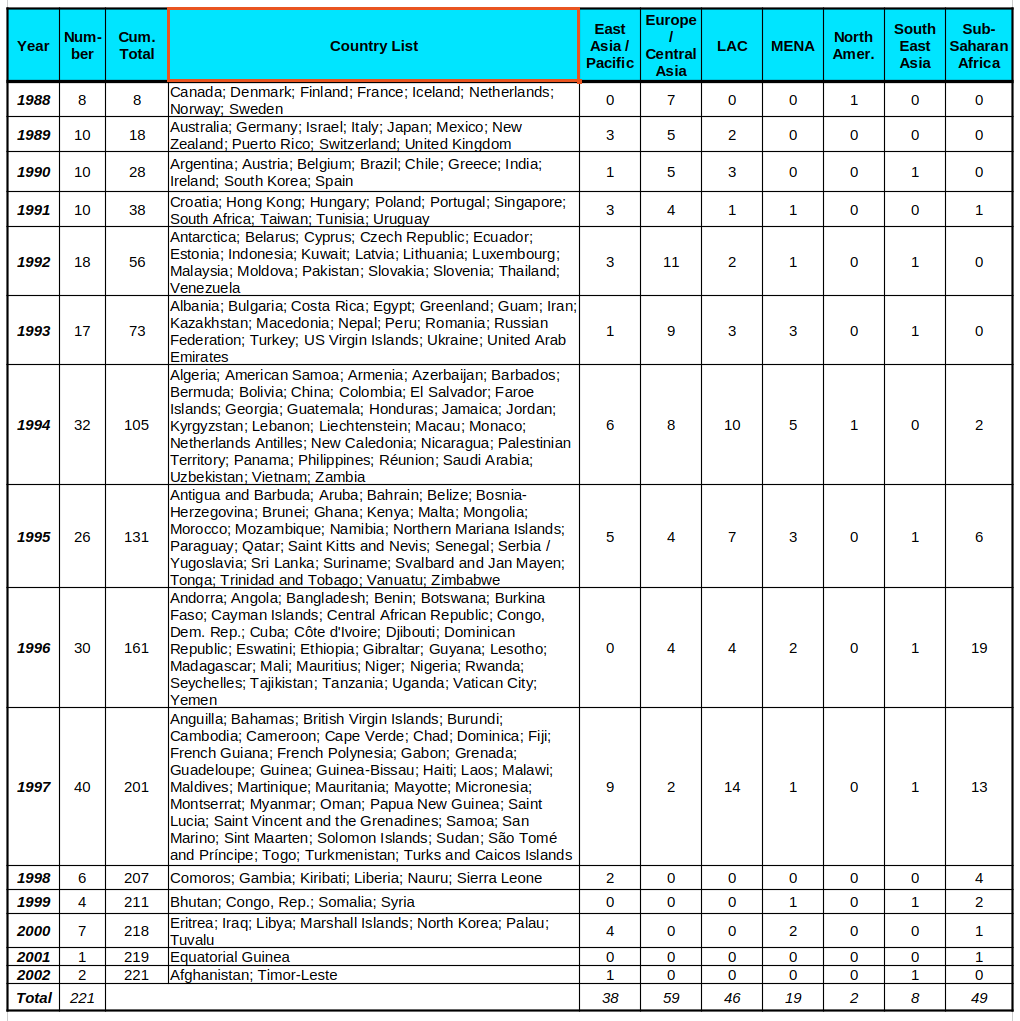
The data shows interesting patterns. First, international Internet uptake got off to a slow start. Recall that the existing US academic network of networks formally adopted TCP/IP in 1983, while the NSFNet was launched in 1985. It thus took a few years for other countries to embrace the internetwork. As expected, the first eight, comprising Canada and seven European nations, were advanced capitalist countries. The following year saw the same trend, adding 10 new countries, with Mexico and Puerto Rico as exceptions.
In fact, European and Central Asian (ECA) countries dominated the scene between 1988 and 1993. By the end of that year, 41 ECA countries, representing 46 percent of the total connected, had already secured Internet access. Geopolitics also played a role here, as the fall of the USSR opened the door for former Soviet republics and Eastern European countries to quickly join the network, with support from the US and other Western powers and organizations. Indeed, 21 countries from that group secured access, including former republics that quickly split up after 1990.
Tunisia was the first African country to connect in October 1991 via France, while South Africa became the first sub-Saharan country to do so via Portland, Oregon, about a month later. Latin American nations took center stage between 1994 and 1995, representing 17 of the total 52 countries that connected during that period. And for the first time, eight African nations joined the internetwork in one calendar year, most with direct support from NSRC. Africa then took the leadership between 1995 and 1996 when 32 countries connected. Again, support from the USAID-funded Leland Initiative and the NSF-funded NSRC played a critical role in this process. In 1997, most countries connected, spearheaded by Caribbean nations and many African countries, while the Asia-Pacific recorded its highest number ever. By then, over 200 countries and territories were part of the now truly global Internet.
At least until 1995, the US served as the main backbone of the nascent network. That meant Internet packets traveling between countries were routed via US networks. In principle, then, a connection going from Tunisia to South Africa, from Argentina to Brazil, or from Norway to France traveled in a centralized fashion. Not that traffic between them was overwhelming at the time.
That was why, in 1991, we decided to start playing with traceroute, which, as its name suggests, uncovers the routes IP packets take as they travel from my network to their final destination. You can think of it as an airplane that makes multiple stops before reaching its final destination. However, packets usually take milliseconds to travel, not the long flight hours many of us have experienced—never mind the jet lag we are gifted when we travel across different time zones.
The screenshot below shows the route my local computer network takes to reach Anthropic’s Claude in California. I have edited out the localhost name and IP address. By the way, traceroute is also available on Macs and Windows machines. Graphical versions are also available for those who are still afraid of the command line.
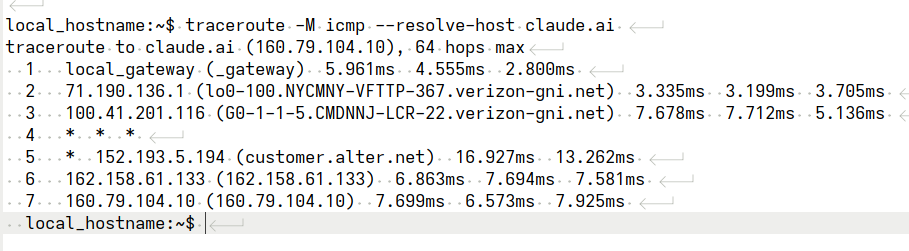
In case you are wondering, “hop” is a synonym for “stop.” Here, a stop occurs when a packet reaches a router, a switch, or a firewall, among other devices. In this case, the trip from home to Claude has seven stops. The numbers in milliseconds (ms) represent the round-trip time (RTT) of the packets. The command sends three packets per hop, so we have three RTTs for each. Note that hop 4 returns no data. That is probably an alter.net firewall that prevents that from happening for security reasons. Hop 5 is the slowest of all, while hops 6 and 7 do not immediately reveal their hostnames. That we can uncover manually. Hop 6 is a Cloudflare network located in Newark, New Jersey. Hop 7 is Anthropic in San Francisco. The flight between Newark and San Francisco has no stops whatsoever, and it is very speedy indeed.
In any case, back in the early 1990s, traceroute was instrumental in empirically demonstrating that the allegedly decentralized Internet was anything but. Here, we must bear in mind that we are talking about connecting networks, not single computers.
In the early days of the global Internet, the goal was to be connected, while the how was low on the priority list. That is surely fine as long as packet traffic does not overwhelm the backbone networks. That can also have substantial economic costs for those running such networks, especially if they are academic or nonprofit.
The interconnectivity issue has at least four layers. 1. Local. 2. Regional. 3. National. And 4. International. The first three apply to each nation-state, while the last pertains to international traffic. In a nutshell, all national traffic should remain within national boundaries. The same applies to cities and provinces or states. Packets moving within the NYC metro area should not travel through, say, Illinois or California. Traffic between neighboring provinces or states should remain in that same region. And so on and so forth.
International traffic should follow similar principles. However, that is not what usually happens. Just like the electric telegraph of the 19th century and the railways of the late 1800s and early 1900s, the main Internet backbones and routes were initially designed to serve their creators, typically hegemonic powers and most developed nations. Indeed, technology diffusion follows the same patterns as global capitalist development, which is highly uneven globally. No one should be surprised by such developments.
However, that does not address the national backbone issue. In the US, the NSF consistently supported the development of the US Internet backbone, namely NSFNet, and provided a clear rationale for deploying internetwork connectivity in a structured fashion. NSFNet backbone infrastructure development and support were provided by carefully selected US companies, including IBM, MCI and Merit. In 1991, the NSF removed restrictions that had prohibited commercial traffic over its backbone, opening the door to the emergence of Internet Service Providers (ISPs) and laying the groundwork for privatization.
In 1993, the NSF introduced the concept of Network Access Points (NAPs) as a precondition for the upcoming backbone privatization and to avoid a possible Balkanization of the backbone networks. NAPs were supposed to provide layer 2 (data link) services within the TCP/IP four-layer protocol. In simple terms, a NAP was a “room” where various ISPs could connect to a switch port and directly link to other ISPs and networks. In principle, NAPs were agnostic to IP routing and protocols, as well as to the applications running over the network. NAP clients did that job. But that is not exactly what happened on the ground. By the way, the NSF NAP proposal also introduced the idea of Network Service Providers (NSPs), which we now call ISPs.
The NSF proposed four regional NAPs (New York, Washington, D. C., Chicago and San Francisco) but unfortunately decided to assign their management to telecom companies that could, in principle, also become NSPs. Those companies included Sprint, MFS Datanet, Ameritech, and Pacific Bell, none of which exist as such today. AT&T (Ameritech and Pacific Bell, 2006), T-Mobile (Sprint, 2020) and Verizon (MFS, 2006) replaced them via mergers and acquisitions. In any event, competition between NAP providers and NSPs, combined with rapidly increasing Internet traffic that created serious network bottlenecks, eventually brought down the NAPs. High-end NSPs began creating their own access points, thereby bypassing all NAPs while reducing their networking costs. A more detailed history of this transition is here.
However, the NSF’s NAP model was based on legacy Internet Exchange Points (IXPs). The Federal Internet Exchange, launched in 1989, connected several research networks, including NSFNET, NASA, the Energy Sciences Network and MILNET. CERN’s IXP was also launched that same year in Geneva; it connected directly to the NSFNet via a T1 line. In 1991, CIX (Commercial Internet Exchange) became the first commercial IXP, challenging the NSFNet commercial restrictions. MAE-East, a joint creation of MFS and UUNET, became the first non-governmental IXP in 1992. As mentioned above, NSF selected MFS to run the Washington, D.C. NAP. These early IXPs offered the NSF blueprints it could have used to ensure NAPs were carrier-neutral and had open governance mechanisms in place to ensure resiliency.
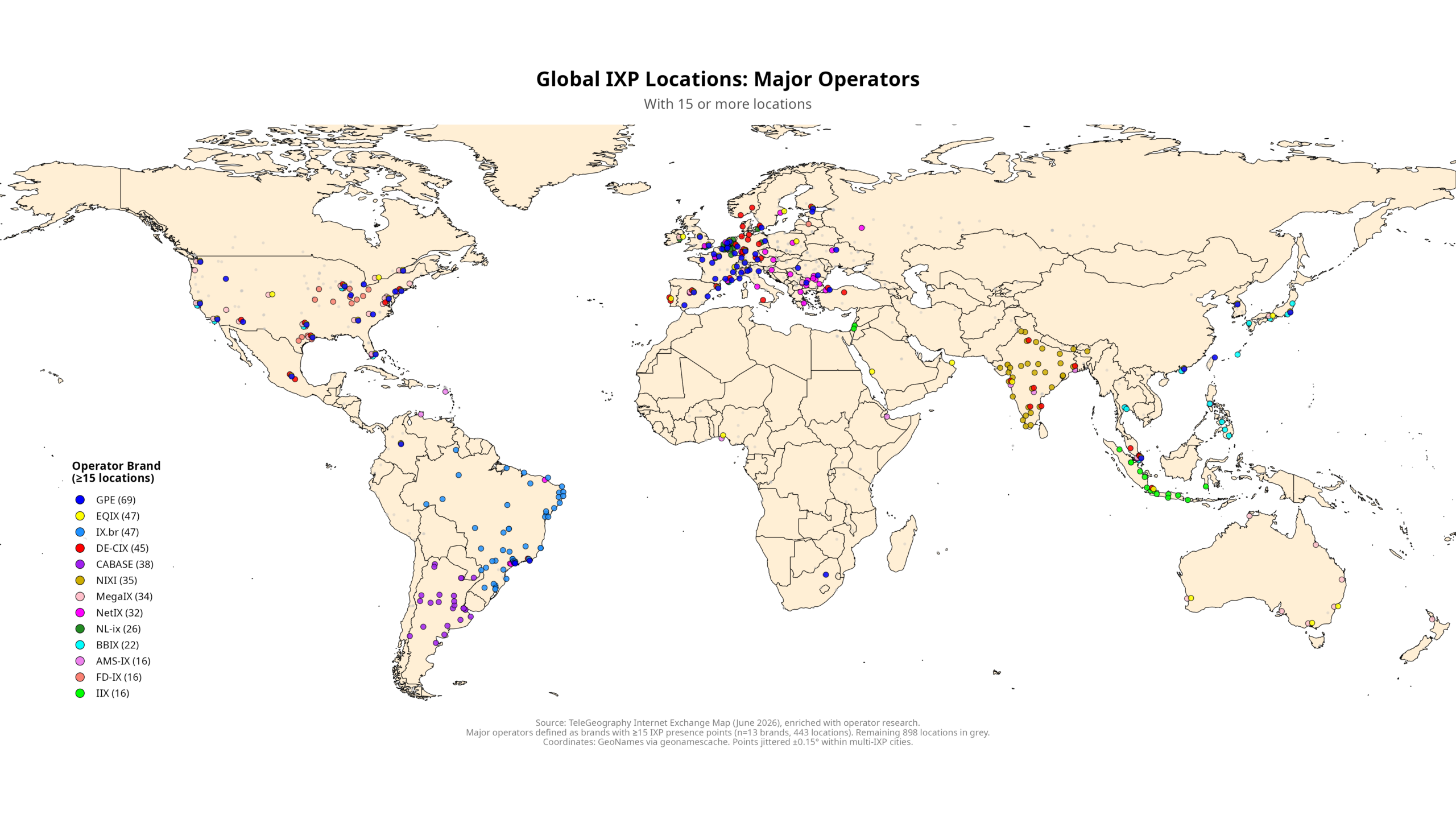
Between 1994 and 1998, additional IXPs emerged in Europe and Asia, including LINX in London (1994), AMS-IX in Amsterdam (1994), NSPIPX in Japan (1994), HKIX in Hong Kong (1995), DE-CIX in Frankfurt (1995), NIX in South Korea (1995), IX-Australia (1997) and Equinix in the US (1998). Today, Equinix is one of the world’s largest data center providers. Tracing this expansion from IXP could be interesting. In any event, these developments show us that the Internet backbone was becoming truly international, at least in the developed world.
The above also provides context for the challenges developing countries have faced in connecting to the Internet. That led to the now-famous Internet peering and settlement debate, which began in 1996, ended almost a decade later, and resulted from the asymmetric architecture of the Internet backbone I described above. It did place a financial burden on developing economies that had to pay in full to remain connected to the Internet. No free lunches were ever available. Although they lost that battle, international bandwidth prices fell rapidly as submarine fiber-optic cables were deployed globally.
Regional IXPs also began to emerge in the early 2000s, further reducing connectivity costs and, in most cases, routing local traffic, as per the four principles mentioned above. However, international traffic is still quite asymmetric.
Raul
